
Practical Sales Training™ > How To Keep Your Clients Happy > The SLA Effect

The SLA Effect
What Is It
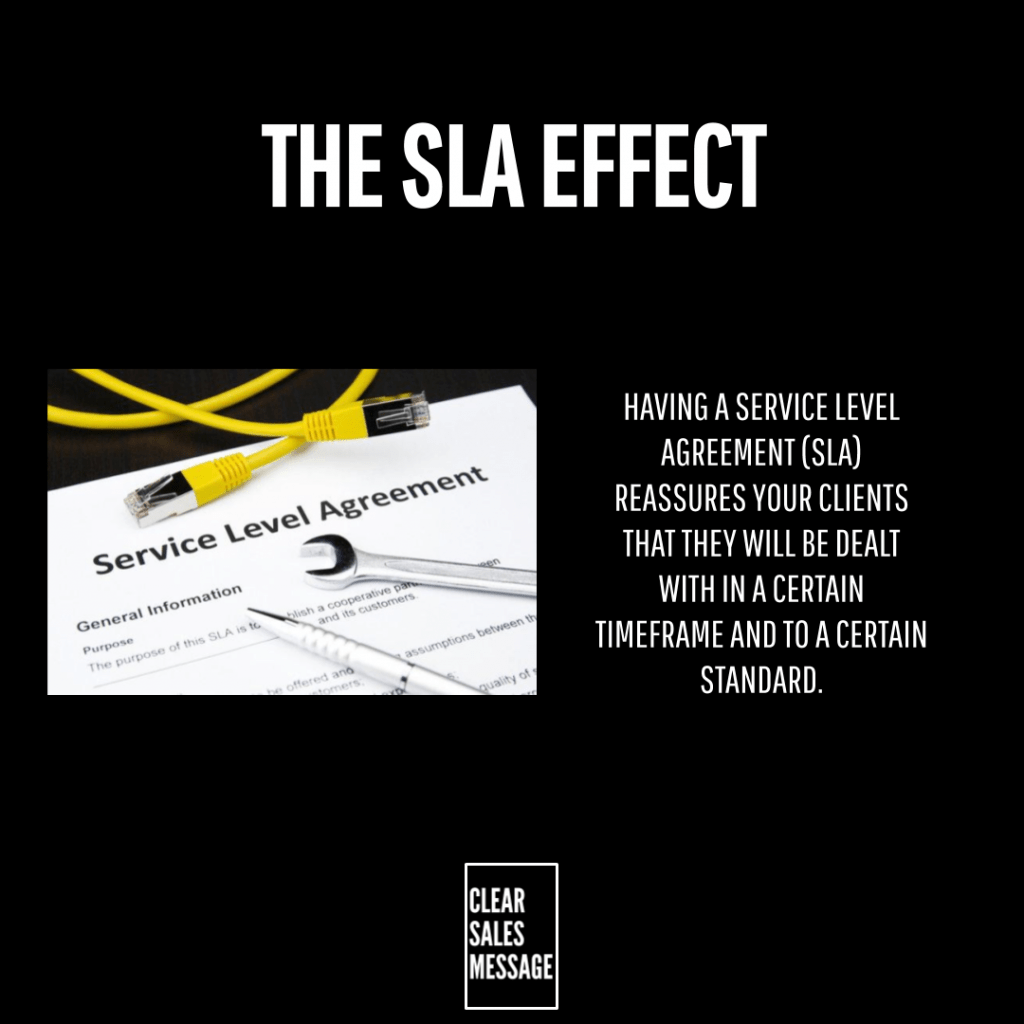
The SLA Effect is all about establishing service levels that you’ll adhere to when dealing with clients. Not a vague promise, an actual commitment with a number attached.
Most businesses imply good service. Very few state it in terms a client could hold them to.
That gap between implying and stating is exactly what this effect closes.
Why Does It Work
Being clear about the level of service a client can expect, and the timeliness of communication or requests, eliminates a lot of the unknowns. It reassures the buyer that they’ll genuinely be looked after.
A Service Level Agreement is exactly that, an agreement for certain service standards. It turns a vague hope into a stated fact.
There’s a confidence effect underneath it too. Stating a specific number takes real nerve, and buyers read that nerve as proof you’re confident you can deliver it.
How Can You Use It
Decide what you’re genuinely willing to commit to
Depending on your offering, what could you commit to in terms of the level of service you offer your clients? Could it be working within certain timeframes, or identifying certain amounts or quality of your deliverable that can be externally verified?
Cover the moments clients actually worry about
Potential service level agreement items:
- Time to respond to calls/emails
- Time to respond to help requests
- Time to resolve help requests
- Time to deliver results
Make it visible, not just contractual
If you can implement SLAs, it ensures both you and your clients know what to expect at each interaction. Show it clearly, not just buried in a contract nobody rereads.
When It Works Best
This works best in ongoing service relationships, support, maintenance, and anything where a client interacts with you repeatedly over time.
It also works best against vague competitors. The clearer your standard, the sharper the contrast with a rival who won’t commit to any number at all.
When It Becomes Dangerous
It backfires the moment you miss the standard you set. A broken SLA damages trust far more than never publishing a number in the first place.
It also becomes risky if the commitment is unrealistic under real pressure. A promise that only holds on quiet days isn’t a genuine SLA, it’s a hopeful guess.
Overcomplicating it causes its own problem too. Too many metrics at once can confuse clients rather than reassure them.
Common Mistakes
Setting a standard you can’t consistently hit
An SLA that only works when your team isn’t busy isn’t really a standard. Set numbers you can meet even on a difficult week.
Hiding the SLA in a contract nobody reads
An SLA only reassures a buyer if they actually see it. Display it clearly on your website and in your proposals, not just buried in the fine print.
Measuring too many things at once
A handful of clear commitments reassures more than a long list of metrics. Pick the ones that genuinely matter to the client.
The SLA Effect – An Example
A Web Design Agency
Business Type: Web Design Agency
SLA Example: “Your Site, Supported – Guaranteed”
How they use it: As part of their support packages, the agency outlines a clear SLA on their website and in client contracts:
- ✅ All emails responded to within 24 business hours
- ✅ Critical website issues resolved within 4 working hours
- ✅ Minor updates (text/images) completed within 2 business days
- ✅ Monthly uptime report and security scan included
They display this in a visual “Service Guarantee” badge on their proposals and checkout pages.
Why it works: It builds buyer confidence by removing ambiguity, and reduces friction for new clients unsure about support. It also creates accountability on both sides, since expectations are clear, and becomes a genuine sales differentiator against competitors who stay vague.
See also:
- KPI – Key Performance Indicator
- QER – Quantifiable End Result
- 40+ ways to keep your buyer happy
- 100+ ways to differentiate