
Practical Sales Training™ > How People Work > The Recency Effect

The Recency Effect
What Is It
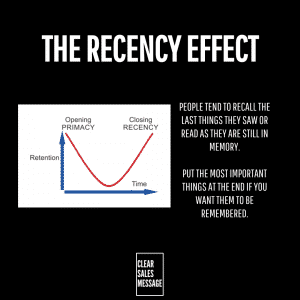
The Recency Effect addresses the fact that we’re more likely to recall the first and last thing we see and hear. What happens in the middle gets recalled far less.
It’s not that the middle content doesn’t matter. It’s that the brain simply holds onto less of it, no matter how good it was.
So the position of a point matters almost as much as the point itself.
Why Does It Work
The human brain can only process so much information, and it does so sequentially. At the start and the end of anything, our attention span naturally peaks. So that’s the best time to make the most salient points in your sales messaging.
In the middle, attention drifts. A reader skims, a listener’s mind wanders, and detail simply slips away, even when the content itself was strong.
As a result, the ending isn’t just a formality. It’s often the only part that survives in someone’s memory once the conversation ends.
How Can You Use It
Back load your strongest point
To drive home key points in emails and presentations, you can back load your key content, or repeat the key content at the end, to ensure it’s more likely to be recalled.
Close with a one line summary
Ending an email or presentation with a line that sums up your point will maximise the chances of The Recency Effect. So don’t just trail off, land on the thing you most want remembered.
Match the ending to the opening
Since both ends get recalled best, make sure they agree with each other. An opening promise and a closing recap that echo the same idea reinforce it twice, rather than splitting attention across two different points.
When It Works Best
This works best in anything with a natural middle to lose attention in, longer emails, presentations, proposals, and sales calls.
It also works best when you genuinely have one strongest point to land on. Trying to end on three equally weighted ideas dilutes the effect completely.
When It Becomes Dangerous
It backfires if your ending doesn’t match what actually came before it. A confident closing line built on weak middle content just highlights the gap, rather than covering for it.
It also becomes risky if you rely on it as a substitute for a genuinely strong middle. The Recency Effect helps recall, but it can’t rescue an offer that was never compelling in the first place.
Overusing the technique flattens it too. If every single message ends with an identical, punchy recap, it starts to read as a formula rather than a genuine summary.
Common Mistakes
Ending on logistics instead of the message
“Let me know if you have any questions” is a fine closing courtesy. But it wastes the single best spot in the whole message to reinforce your actual point.
Introducing a new idea right at the end
The final line should recap, not introduce. A brand new point at the very end competes for the one slot that should be reinforcing what came before.
Making the recap too long
A summary that runs several sentences stops being a recap and starts being another middle section. Keep the final line short enough to actually stick.
The Recency Effect – An Example
A Proposal Email
You’re sending a proposal email to a potential client. Instead of just ending with:
“Let me know if you have any questions.”
You end with:
“To recap: This strategy will help you attract better leads, close more confidently, and finally grow on your terms. If that sounds good, let’s get started.”
Why it works: That last sentence sums up the key benefits in a way that sticks in the reader’s mind. So even if they skimmed the middle, they’ll leave with your message in focus.
See also