
Practical Sales Training™ > How to connect with your buyer > The Range Effect

The Range Effect
What Is It
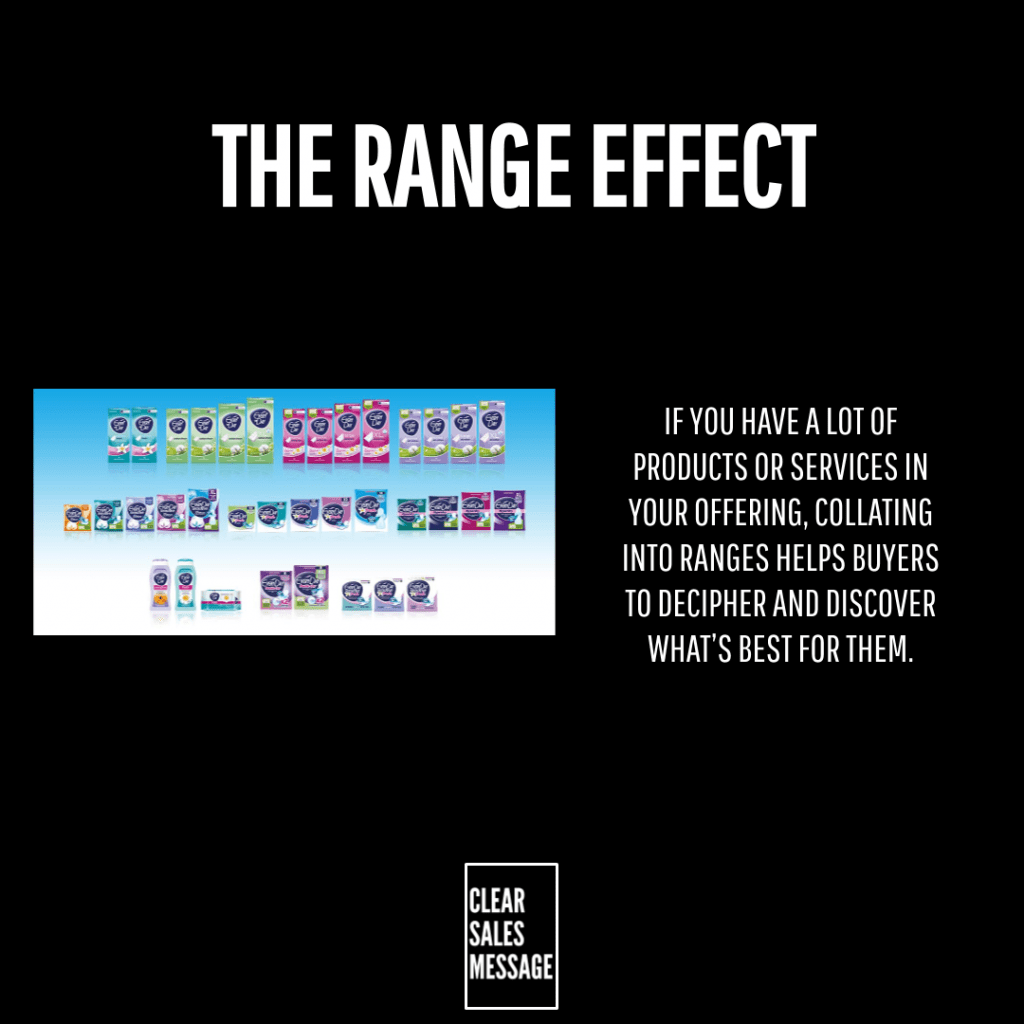
The Range Effect looks at collating your offering into defined ranges and collections. Instead of one long list, buyers see a handful of clear groups.
It sounds like simple organisation. But the difference between a wall of options and a few named groups changes how confident a buyer feels choosing at all.
A range gives structure to something that would otherwise feel overwhelming.
Why Does It Work
It’s a variation of clustering. Creating ranges or collections makes it easier for your buyer to navigate your offering, and it works well alongside product codes and other conveniences.
Buyers faced with too many individual choices often freeze rather than decide. A range narrows that huge decision down to a much smaller, more manageable one.
It also signals understanding. A named range built around a specific need shows you’ve already thought about who that buyer is, before they’ve said a word.
How Can You Use It
Choose a grouping that matches how buyers actually think
Depending on your offering, are there obvious ways to collate in terms of end user, use, price, colour, size, or other factors? This works really well for larger, more complicated offerings.
Name each range around the outcome, not the ingredients
A range named after what it does for the buyer, rather than what’s inside it, helps them self select instantly. Naming by outcome does more work than naming by category alone.
Keep the ranges few and genuinely distinct
Too many overlapping ranges recreate the same confusion you were trying to remove. A handful of clearly different groups works better than a dozen similar ones.
When It Works Best
This works best when you have a genuinely large or varied offering, dozens of products or services that would otherwise overwhelm a buyer if listed flat.
It also works best when your buyers have clearly different needs from one another. The more distinct those needs are, the more naturally the ranges divide.
When It Becomes Dangerous
It backfires if the ranges overlap too much. A buyer unsure which range actually fits them ends up more confused than if there’d been no grouping at all.
It also becomes risky if you create ranges just to sound comprehensive, rather than because buyers genuinely need the distinction. Padding out a range with items that don’t belong dilutes the whole idea.
Renaming or restructuring ranges too often causes its own damage too. Buyers who learn one structure, then find it changed, lose the confidence the ranges were meant to build.
Common Mistakes
Grouping by your own internal logic, not the buyer’s
Organising products by supplier or manufacturing process makes sense to you, but rarely to a buyer. Group around what matters to them instead.
Creating too many ranges
Eight overlapping ranges recreate the exact overwhelm the effect is meant to solve. Fewer, clearer ranges beat many similar ones.
Naming ranges vaguely
A range called “Collection A” tells a buyer nothing. Name it after the specific outcome or need it addresses instead.
The Range Effect – An Example
A Skincare Brand’s Product Ranges
Imagine you’re a skincare brand. Instead of listing all 37 products individually, you organise them into clearly defined ranges:
- “Clear Skin Range” – for acne-prone skin
- “Hydrate Range” – for dry or sensitive skin
- “Age Defy Range” – for anti-ageing support
- “Essentials Range” – everyday basics for all skin types
Why this works: It’s far easier for buyers to find what’s right for them, and it shows you understand different buyer needs rather than treating everyone the same. It also reduces decision fatigue by narrowing 37 choices down to four, while creating a real sense of completeness across the whole range.
See also