
Practical Sales Training™ > Convert > The Discount Effect

The Discount Effect
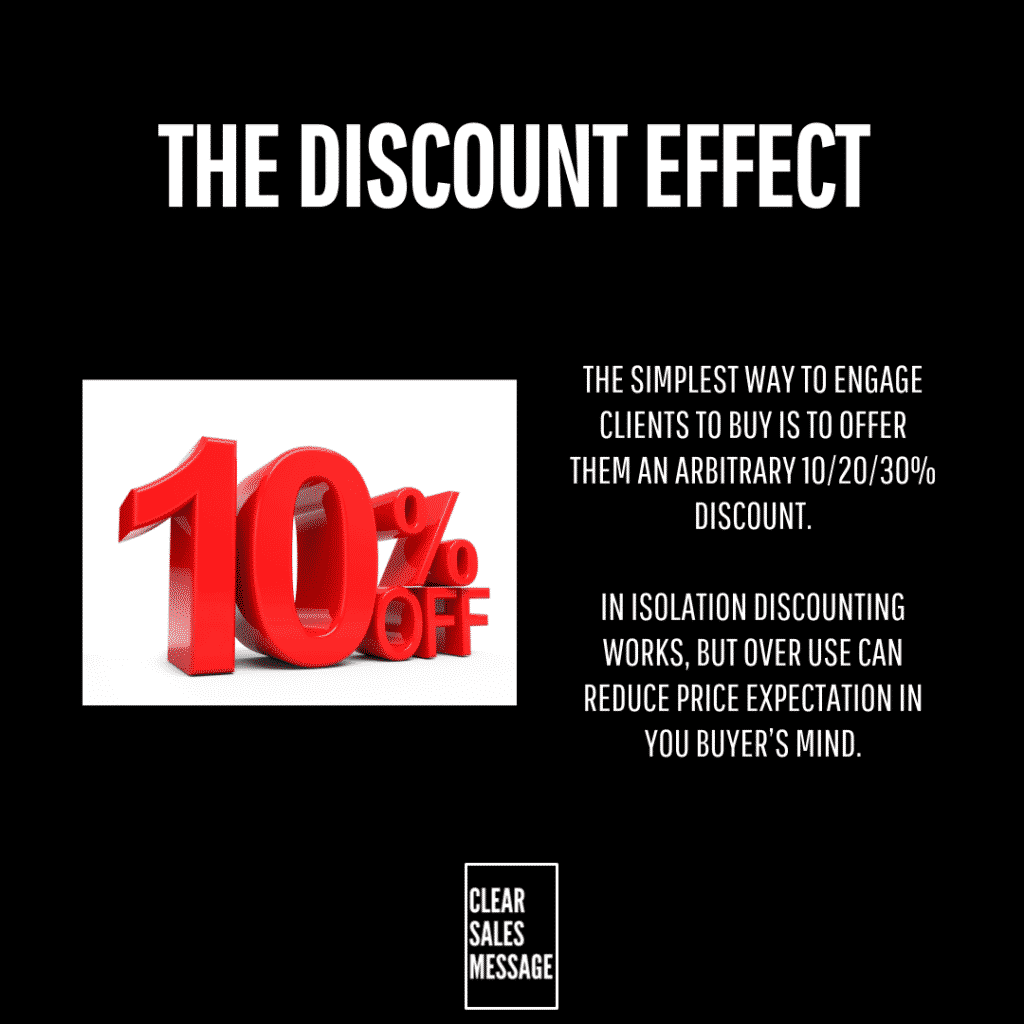
Nothing moves a hesitant buyer faster than a lower price. It’s simple, it’s obvious, and it works almost every time.
But there’s a catch. Use it too often, and your buyer stops seeing it as a discount at all. They just see your new, permanent price.
What Is It
The Discount Effect is one of the simplest ways to convert a buyer. You make your offer cheaper, and cheaper is easier to say yes to.
Why Does It Work
It works because it removes the biggest objection in the room. Price. Whether it’s a sale, a voucher code, or a straight markdown, a lower price makes your offer more appealing and more accessible.
But there’s a risk hiding underneath that logic. Discount an offer all the time, and buyers start to see it differently than one you sell at a steady, fair price. Your buyer stops asking “should I buy this” and starts asking “when will it be cheaper again.”
How Can You Use It
You can discount almost any offer at almost any point. But it’s a risky move unless you use it sparingly and tie it to something specific.
If you do discount, attach it to a reason. An event, a special deal, or some outside factor your buyer can point to. This stops them expecting a discount every time, and it protects how they see your offer the rest of the time.
Common Discount Types
A welcome discount rewards a new buyer for taking the first step. An anniversary discount thanks them for sticking around. A birthday discount makes it personal, since you tie it to them, not your sale calendar.
A reorder discount rewards buyers for coming back. A green discount rewards a specific choice, like choosing a lower impact option. A competitor discount gives buyers a reason to switch, rather than just a reason to wait.
When It Works Best
This works best when you attach the discount to a clear, specific reason. A birthday, an anniversary, a seasonal event. The reason does most of the work, since it explains why the price is lower right now and not always.
It also works well as a one time nudge for a hesitant buyer, rather than a constant feature of your pricing.
When It Becomes Dangerous
Discount too often, and your buyer starts to distrust your full price completely. They wait, because they’ve learned that waiting pays off.
It also flattens how buyers see your offer. Something that’s always on sale doesn’t feel special anymore. It just feels like your actual price, and your margin quietly disappears alongside it.
Common Mistakes
Discounting Without A Reason
A discount with no explanation just looks like your real price with extra steps. Buyers notice, and they’ll wait for it to happen again.
Making It A Habit
Run the same discount too often, and it stops being an incentive. It becomes an expectation instead, and expectations are much harder to undo than they are to create.
The Discount Effect – An Example
Say a new buyer lands on your site for the first time. Instead of showing your standard price, you offer a small welcome discount.
You could frame it like this: “Since this is your first order with us, here’s 10% off to welcome you in.” The reason is specific, and you’ve tied it to a one time moment, not an ongoing feature.
Because you’ve clearly explained the discount, your buyer doesn’t expect it again next time. It did its job, converted the sale, and protected your normal price for every order after it.
See Also