
Practical Sales Training™ > How To Convert > The Collectable Effect

The Collectable Effect
Nobody wants to be the only one without the full set. So once you’ve got three out of five, you want the other two too.
That pull is the Collectable Effect. You split a larger offering into pieces. The urge to complete it does the rest.
And it works even when the prize at the end isn’t worth much at all.
What Is The Collectable Effect?
The Collectable Effect is all about having a large offering, sold in sections. It encourages buyers to collect and complete the set. So instead of one purchase, you create a series of purchases tied together by a shared goal.
The individual pieces matter less than the whole. It’s the act of finishing the set that buyers really chase.
Why Does The Collectable Effect Work?
It works because it leans on reactance and reverse psychology. We’re presented with the challenge of collecting everything. We don’t want to feel like we’re missing out, or that others have an advantage over us.
For some people, completing things matters deeply. It becomes a source of pride. That’s why free cards given out at supermarkets can be found for sale online. People literally spend money to complete a task that should have been free.
How Can You Use The Collectable Effect In Sales?
Use it as a marketing tool
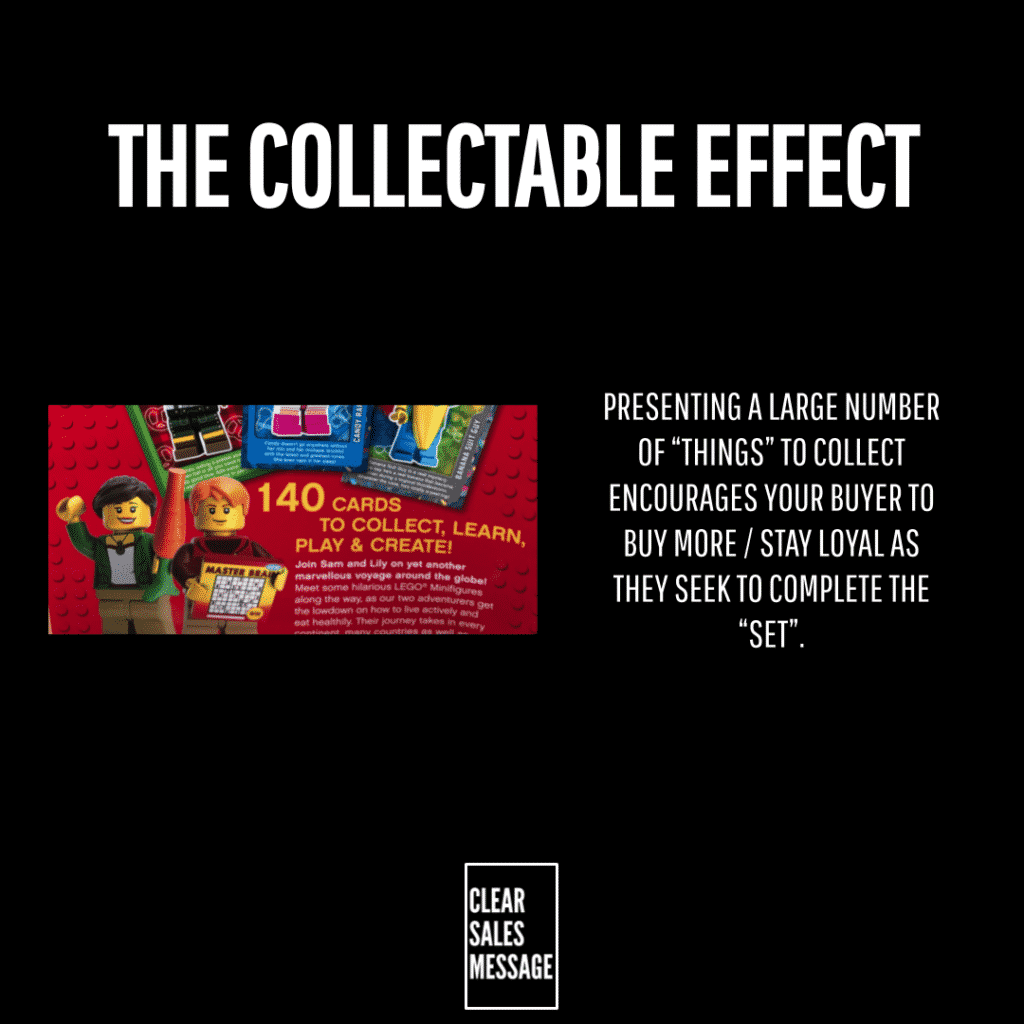
Lego in the UK paired up with Sainsbury’s. They offered free cards that need collecting to complete the accompanying book. In your quest to get more cards, you have to spend more at the shop. So Sainsbury’s saw an increase in sales and loyalty as buyers sought to complete the set.
[PLACEHOLDER: Lego/Sainsbury’s collectables example image – awaiting WordPress upload URL for the-collectible-effect-example-768×455-optimized.webp. Please upload and provide the resulting src and wp-image-ID, then I’ll insert:  ]
]
Use it directly in your sales model
A large offering split into sections can work too. As long as it’s clearly part of a bigger set, it can push buyers to seek out every piece. A prime example is model building magazine subscriptions. You buy a magazine each month, and it comes with a part to build the whole.
[PLACEHOLDER: Model building magazine subscription example image – awaiting WordPress upload URL for the-collectible-effect-example-1-768×286-optimized.webp. Please upload and provide the resulting src and wp-image-ID, then I’ll insert: ]
When The Collectable Effect Works Best
It works best when the set is genuinely finite. Buyers need to know there’s a real, achievable end point worth chasing.
It also works well when each piece feels small and low cost individually. That makes the whole collecting process feel manageable rather than overwhelming.
When The Collectable Effect Becomes Dangerous
It becomes dangerous if completing the set feels almost impossible. Buyers can get frustrated and abandon the chase entirely, taking their loyalty elsewhere.
It can also backfire if the individual pieces feel like poor value on their own. Buyers may resent having to keep paying just to finish what they started.
Common Collectable Effect Mistakes
Making the set too large
If completing the collection takes too long or costs too much, buyers may give up. So keep the set achievable within a realistic timeframe.
Hiding how many pieces remain
Buyers need to track their progress clearly. So always show how close they are to completing the set, not just that a set exists.
Skewing the odds too heavily
If certain pieces are deliberately rare or hard to get, frustration can outweigh the fun of collecting. So balance scarcity carefully against achievability.
The Collectable Effect – An Example
Lego’s Sainsbury’s collectable cards
Sainsbury’s regularly runs a Lego collectable card promotion. Shoppers get free cards with every purchase to complete an accompanying book or collection.
The pull to finish the set drives repeat shopping trips. So the cards become highly sought after, and completed or rare ones often end up for sale online. People pay for something that was originally free.
See also