
Practical Sales Training™ > How People Work > The Abundance Effect

The Abundance Effect
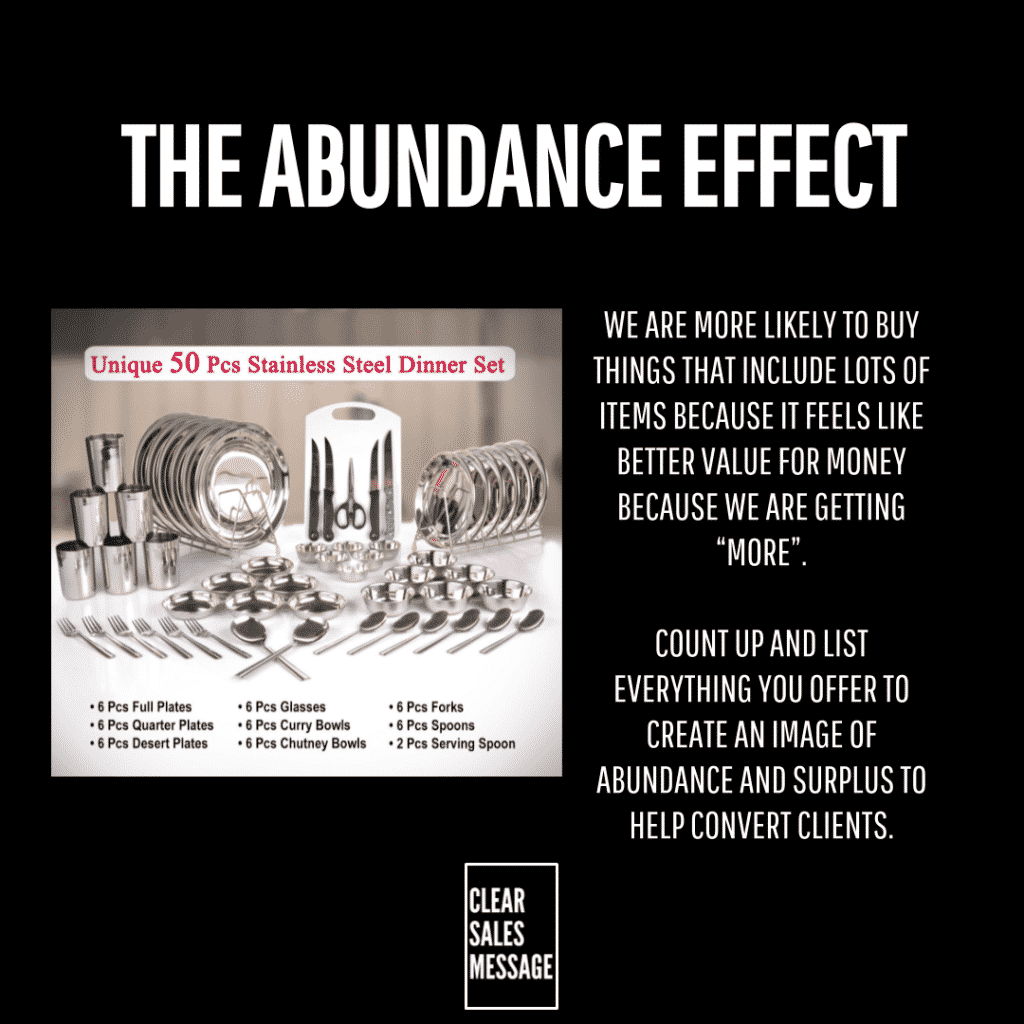
Two offers. Same price. One says professional cleaning service. The other lists fifty tasks across kitchen, bathroom, and living areas. Both do the same job. But one feels like far better value. That is the Abundance Effect.
When buyers see more, they feel they are getting more. The list, the count, the itemisation. Each one signals that this offer is substantial and worth the money.
The Abundance Effect is when buyers perceive an offer as better value because it contains many items. Even when those items add little real difference, the impression of more persists.
What Is The Abundance Effect?
Buyers are always looking for the best deal. When two offers sit side by side, the one with more components feels more thorough and worth the price. That judgement happens quickly and often without much conscious thought.
There is also a justification effect. When a buyer commits to a purchase, they want to feel the decision was rational. A long list gives them that. It gives them something to point to when they explain the choice to themselves or to someone else. Because the list is there, the purchase feels justified.
It also reduces doubt. A short description leaves gaps for the buyer to fill in. An itemised list leaves fewer gaps. So the more you detail, the less room there is for uncertainty.
Why Does The Abundance Effect Work?
We process what we can see. A long list of items is visible and countable. A vague promise of quality is not. Because buyers cannot evaluate a service before they buy it, they look for signals that suggest it is substantial. A detailed list is one of the strongest signals available.
There is also the feeling of getting a good deal. We do not often add up whether we will use everything we buy. We just notice that there is a lot of it. A gym membership with a long list of included classes feels more worthwhile than one with a short list, even if the buyer only ever attends one class. Often we do not need or use all the extra items, but we are happy to have them anyway.
The effect is also hard to fake in a bad way. When a seller itemises their offer in detail, they demonstrate knowledge and confidence. Because they know their product well enough to describe every component, buyers trust them more.
How Can You Use The Abundance Effect?
Start by listing every single component of your offer. Every feature, every step, every included item. For a service, list every task; for a product or course, list every part, module, and lesson.
Go Into Detail Within Each Item
Within each item, add a line of detail. Not just kitchen cleaning but wiping down appliances, descaling the sink, cleaning inside cupboards, and polishing tiles. That level of detail signals care and thoroughness before the buyer has experienced either. The extra specificity does not add cost. But it does add perceived value.
Use Numbers and Bullet Lists
When you present the list, format matters. A long bullet list looks more substantial than the same content written as prose. Numbers help too. Fifty tasks feels more tangible than a thorough clean. Name the number and show the breakdown. The visual weight of a long, well-organised list is part of the effect.
List Inputs, Not Just Outputs
Delivering a clean house is an output. Performing fifty specific tasks is an input that the buyer can picture, compare, and value. Inputs feel more substantial because they are specific and checkable. So wherever possible, describe what you will do rather than just what the buyer will get.
When The Abundance Effect Works Best
The Abundance Effect works best when the offer sits alongside alternatives. When a buyer compares your itemised offer to a rival’s vague description, the gap in perceived value is significant. Specificity beats brevity at the point of comparison.
It also works well when buyers judge by what they can see, not what they can test. Because a service outcome is hard to evaluate before purchase, the list becomes a proxy for quality. The more detailed it looks, the more capable the supplier appears.
It is also particularly effective for service businesses where the scope of work is not obvious. Cleaning, consulting, web design, financial planning. In all of these, buyers have little idea what is actually involved. A detailed list educates and reassures them at the same time.
When The Abundance Effect Becomes Dangerous
One main risk is listing things that feel trivial or self-evident. When your list includes items so basic that any provider would do them, it can undermine trust. Buyers notice when padding replaces genuine detail. Every item on the list should feel like something worth pointing out.
There is also a readability risk. A list so long that no one reads it has no effect. The list needs to be long enough to impress but organised enough to scan. Group items into clear categories and use numbers. That keeps the impression of abundance without the confusion of an unstructured wall of text.
Common Abundance Effect Mistakes
Under-Listing
The most common mistake is under-listing. Most sellers describe their offer in summary form, as if brevity signals confidence. For the Abundance Effect to work, brevity is the enemy. Get into the detail. Name the parts. Count the steps. The seller who itemises wins over the one who summarises.
Listing Without Grouping
A long flat list with no structure is hard to process. Buyers scan rather than read. So group your items into clear categories and label each group. That makes the list feel organised and thorough at the same time. A well-structured long list is more persuasive than an unstructured one of the same length.
Padding With Obvious Items
Adding items to a list just to make it longer can backfire. When a buyer sees something on the list that is so basic it goes without saying, it raises a question about everything else. Keep the list to things that are genuinely worth stating. Quality of items matters as much as quantity.
The Abundance Effect – An Example
A home cleaning company creates a 50-Point Deep Clean Package and lists every task they cover. Ten kitchen cleaning tasks including appliances, cupboards, and tiles. Fifteen bathroom tasks including scrubbing, descaling, and mirrors. Twenty-five living and bedroom tasks including dusting, vacuuming, and windows. Each item is standard. But the list makes the service feel thorough, meticulous, and worth every penny. A rival who says we clean your house thoroughly will lose that comparison almost every time.
Value was there before the list. The list just made it visible.
See Also
- The Unlimited Effect
- Future Updates
- 50+ ways that people work & make decisions
- 100+ ways to differentiate