
Practical Sales Training™ > How To Convert > Problem Solution Grid

Problem Solution Grid
Most buyers arrive with a problem, not a brief. They are not thinking about your service categories or your product features. They are thinking about what is going wrong and what they need to fix. So if your messaging is built around what you do rather than what you solve, many buyers will miss the connection entirely.
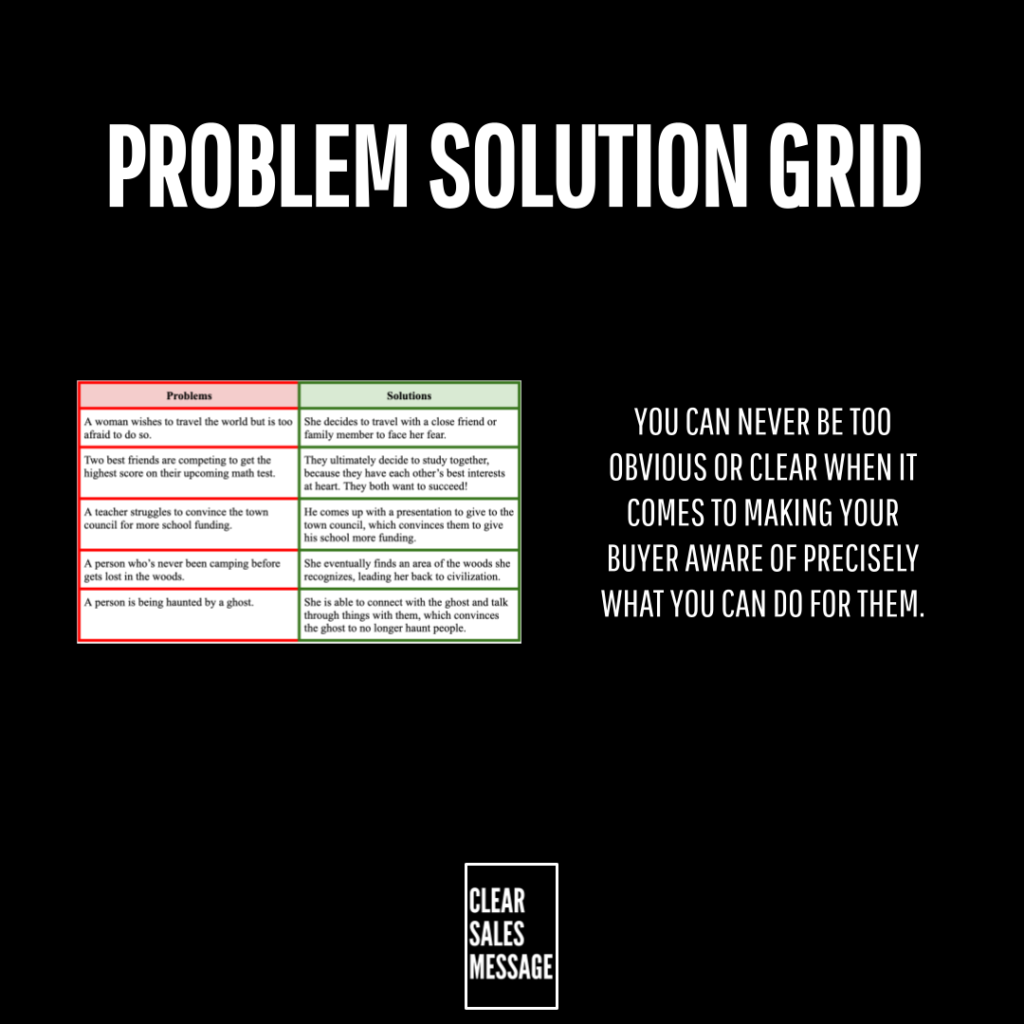
A Problem Solution Grid closes that gap. It takes the problems your buyers actually have and maps each one to the part of your offer that resolves it. The buyer reads it and immediately thinks “that’s me.” That moment of recognition is one of the most powerful things you can create in sales communication.
In selling, you can never be too clear. The easier you make it for a buyer to understand how you help them, the more likely they are to buy. A Problem Solution Grid is one of the simplest ways to achieve that clarity.
What Is a Problem Solution Grid?
A Problem Solution Grid is a simple document or visual that lists the problems you solve on one side and links each one to the relevant part of your offering on the other. It can be a one-pager, a section of your website, a slide in a pitch deck, or a tool your sales team uses in conversation.
The format does not need to be complicated. Problem on the left, solution on the right. That structure is enough. Because the link between the two is made explicit, the buyer does not have to work it out for themselves. You have done that work for them.
It can also work as an internal document. A grid that helps your team quickly match a buyer’s stated problem to the right part of your offer makes every sales conversation faster and more focused. Whether it faces the buyer or supports the seller, the principle is the same.
Why Does a Problem Solution Grid Work?
It works because it follows the path of least resistance. Buyers do not want to navigate your whole offering to figure out if you can help them. They want a quick answer to one question: do you solve my problem? A Problem Solution Grid answers that question without making them search for it.
There is also a self-qualification effect. When buyers read a list of problems and recognise their own situation, they feel understood. That feeling creates an immediate connection. Because you have named their problem accurately, they assume you understand it deeply. And if you understand it deeply, you are probably the right person to fix it.
It also reduces the risk of buyers talking themselves out of a conversation. When the offer feels complex or unclear, buyers hesitate. A grid removes that complexity. Because the match between their problem and your solution is visible and direct, the decision to get in touch becomes much easier to make.
Finally, it makes your offer easier to share. A buyer who sees their problem on your grid can send it to a colleague or a decision-maker with a simple note. Because the grid does the explaining for them, the message travels clearly without getting lost in translation.
How Can You Use a Problem Solution Grid In Sales?
The process is straightforward. Start with the problems, not the solutions.
1 – Define the problems you solve. Think about the real language your buyers use. Not your internal descriptions of the issue, but the words they say out loud. Write those down.
2 – Link each problem to the part of your offering that solves it. Be specific. A vague solution does not reassure a buyer the way a direct one does. Name the service, the product, or the approach that addresses each problem.
3 – Create a simple one-pager with the above. Keep it clean and easy to scan. The goal is instant clarity, not a detailed brochure. If a buyer cannot find their problem in thirty seconds, simplify the layout.
Use It on Your Website
A Problems We Solve section on your website does two things at once. It helps buyers self-qualify quickly, and it tells search engines what problems you are associated with. Because buyers often search by problem rather than by solution type, a grid structured around their language can also bring in more of the right traffic.
Use It in Proposals and Pitches
Opening a proposal with a problem-solution grid shows the buyer that you listened. You are not presenting a standard service menu. You are showing them that you understood what they told you and that your offer is a direct response to it. That approach builds confidence before a single price has been mentioned.
Use It as a Sales Conversation Tool
A grid on a tablet, a printed sheet, or a shared screen in a meeting gives the buyer something to point at. When a buyer can physically indicate “that one, that is my problem,” the conversation becomes far more focused. Because the grid removes the need for a long discovery process, it gets to the point faster and keeps the buyer engaged.
Keep It Concise
A grid with twenty problems becomes hard to scan. Five to eight well-chosen problems, each linked to a clear solution, will do more for conversion than a comprehensive list that overwhelms the reader. Focus on the problems that appear most often and that your offer solves best. Because brevity makes the grid easier to use, less is almost always more here.
When a Problem Solution Grid Works Best
A Problem Solution Grid works best when buyers arrive with a clear problem but limited knowledge of how you might solve it. In markets where your offer is not immediately obvious from the name or category, the grid does the translation work. It connects what the buyer knows, their problem, to what you offer, your solution.
It also works well in competitive markets where several suppliers offer something similar. When buyers are comparing options, the one that speaks most directly to their specific problem will stand out. A grid that names their exact situation is more persuasive than a polished brochure that describes features in general terms.
Similarly, it works well when your offer covers multiple problems or buyer types. A grid lets you show the full range of problems you solve without making the buyer wade through everything to find their relevant part. Each buyer sees their problem and their solution and nothing else needs to distract them.
When a Problem Solution Grid Becomes Dangerous
The risk is listing problems you cannot actually solve well. A buyer who sees their problem on your grid, buys, and then finds the solution falls short will feel misled. So only include problems you solve consistently and confidently. A shorter, honest grid is far more valuable than a long one that overpromises.
There is also a risk of using your language instead of the buyer’s. If the problems on the grid are written in industry terms or internal jargon, buyers may not recognise their own situation in them. So write each problem the way a buyer would say it out loud, not the way you would describe it internally.
Common Problem Solution Grid Mistakes
Writing Solutions That Are Too Vague
A solution that says “we help you grow” tells the buyer very little. The solution column needs to be as specific as the problem column. Name the thing you do, how it works, and what result the buyer can expect. Because vague solutions create doubt rather than confidence, specificity is what makes the grid convert.
Making It Too Long
A grid that tries to cover every possible problem loses its clarity. Buyers stop scanning and start skimming past. So prioritise ruthlessly. Include the problems that come up most often in your sales conversations and cut the rest. A focused grid gets read. An exhaustive one does not.
Using It Once and Forgetting It
A Problem Solution Grid is not a one-off document. It should appear across your website, your proposals, your social content, and your sales conversations. Because repetition builds familiarity, the more often buyers see their problem matched to your solution, the more confident they become that you are the right choice. So build the grid into your regular communication, not just a single asset.
Not Updating It as Your Offer Evolves
Businesses change. New services get added, old ones get retired, and the problems buyers bring to you shift over time. A grid that reflects where you were two years ago will not serve you as well as one that reflects where you are now. So review it regularly and keep it current. Because it is one of the first things many buyers will see, it needs to be accurate.
Problem Solution Grid – An Example
A digital marketing agency creates a Problems We Solve one-pager and uses it in every proposal and on their website. It looks like this:
Problem: “Our website is not generating leads.”
Solution: “We use targeted SEO and conversion work to bring in the right traffic and turn visits into enquiries.”
Problem: “We do not know how to run ads without wasting budget.”
Solution: “Our paid ads management across Facebook and Google ensures every pound is tracked and working.”
Problem: “We do not have time to manage social media.”
Solution: “Our done-for-you content and scheduling service keeps you visible without the effort.”
Each buyer reads the grid and finds their problem. Because the link to the solution is direct and clear, they do not need to ask whether the agency can help them. The grid already answered that. So the conversation that follows starts from a place of confidence rather than uncertainty. That is the Problem Solution Grid doing its job.
See Also