

Practical Sales Training™ > How To Keep Your Clients Happy > Frequently Asked Questions

Frequently Asked Questions
Every business gets the same questions over and over. Think of the buyer asking about delivery, the customer unsure how to start, or the prospect with an awkward concern. These questions delay decisions and create friction at the worst possible moments.
A Frequently Asked Questions page solves all of this. When you anticipate the questions and answer them clearly, buyers get what they need without waiting for you. Customers serve themselves. And you stop repeating yourself.
Done well, a FAQ also builds confidence. A buyer who can find answers to their questions without asking is a buyer who feels informed. And informed buyers are far more likely to buy.
What Is a Frequently Asked Questions Page?
A Frequently Asked Questions page lists the most common questions buyers and customers have, alongside clear answers. The goal is to give people what they need, when they need it, without requiring them to contact you.
It sits at the crossroads of sales and customer care. For buyers, it removes barriers to the decision. Existing customers reduce their support requests. And your team spends less time on the same handful of questions every week.
A good FAQ also covers the questions people are thinking but not asking. These are often the most important ones. A buyer unsure about switching from a rival, or worried about compatibility, may never ask directly. But if the FAQ covers it, the doubt gets resolved before it becomes a reason to say no.
Why Does a Frequently Asked Questions Page Work?
It works because it gives people what they want, at the moment they want it. A buyer who has a question at 11pm cannot call you. But they can read your FAQ. And if they find the answer, they stay engaged rather than drifting away and forgetting to come back.
It also works because preparation builds trust. A business that has clearly thought about its buyers’ concerns and addressed them proactively signals confidence in its own offering. The FAQ says: we know what you are wondering, and we are happy to answer it.
There is also a conversion angle. Some of the most common reasons buyers hesitate are questions they never voiced. They worry about something, do not raise it, and walk away. A FAQ that covers these unspoken concerns removes doubts that would otherwise stay hidden and kill the sale quietly.
How Can You Build a Frequently Asked Questions Page?
Gather all the questions your buyers actually ask
Start by collecting every question your sales team, customer service team, or inbox receives repeatedly. These are your foundation. If something comes up more than twice, it belongs in the FAQ. Also look at reviews, support tickets, and post-sale surveys for questions that surface after the purchase has been made.
Cover the questions buyers think but do not ask
Look at where buyers hesitate in your sales process. Think about what slows them down, what objections come up, and what they compare you to. These are the questions they are carrying but not voicing. Covering them in your FAQ removes a hidden barrier that you would otherwise have to overcome in person every time.
Group questions by topic
A long list of questions with no structure is hard to use. So organise your FAQ into clear sections: getting started, pricing, delivery, aftercare, troubleshooting, and so on. Buyers looking for a specific answer can find it fast. And grouping by topic shows buyers how much you have thought through, which builds confidence in your knowledge.
Consider adding video answers
Text answers are useful. Video answers are even better. When a buyer can see and hear a real person explain something, the response feels more personal and more credible. Apple does this well, pairing written FAQ answers with short video explanations for key questions. Even a short clip of you talking to camera can make a significant difference to how the FAQ lands.
Topics to Cover in Your FAQ
The most useful FAQs tend to cover the same broad areas. Think about how your product or service maps against each of these and whether you have answered them clearly.
- Compatibility with the buyer’s current setup or equipment
- How to get started and what the first steps look like
- Switching from another supplier to you
- Best practices, tips, and common shortcuts
- How quickly the buyer can expect results
- Delivery times and process
- How long results last
- Warranty and guarantee terms
- Aftercare, parts, and servicing
- Troubleshooting for specific issues
When a Frequently Asked Questions Page Works Best
It works best when buyers face a complex or considered purchase. The more factors a buyer has to weigh up, the more questions they will have. So an FAQ is most valuable when the decision involves investment, change, or risk. In these cases, removing doubt is as important as creating desire.
It also works well for businesses with a recurring customer base. When your clients use your product or service over time, they will run into questions. A well-built FAQ reduces the support burden and helps clients get the most from what they have bought. That improves satisfaction and increases retention.
And it works particularly well online, where buyers research and decide without ever speaking to you. A buyer doing late-night research who finds clear answers is far more likely to buy. One who hits a wall of questions simply moves on.
When a Frequently Asked Questions Page Becomes Dangerous
The risk is letting it go stale. A FAQ that answered the right questions two years ago may now be missing the ones that matter today. Products change, buyers change, and the questions that come up shift over time. So review your FAQ regularly and update it when you notice new questions appearing in your inbox or your reviews.
There is also a risk of making it too long and too hard to navigate. A FAQ with a hundred entries and no clear structure becomes a barrier rather than a help. So keep it focused. Better to cover twenty questions really well than to list every conceivable one and answer none of them clearly.
Finally, a FAQ is not a substitute for a conversation. If a question needs a nuanced answer, do not try to cover every variation in a bullet point. Instead, use the FAQ for common cases and give buyers a clear way to reach you when they need more.
Common Frequently Asked Questions Mistakes
Only answering the easy questions
Many FAQ pages skip the difficult questions, such as pricing, comparisons with rivals, or known limitations. But these are often the ones buyers care most about. Avoiding them in your FAQ does not make them go away. It just means buyers find out by asking or, worse, by going elsewhere. So include the hard questions and answer them honestly. That honesty builds more trust than a polished but incomplete FAQ ever will.
Writing answers that sound like marketing copy
A FAQ answer that sidesteps the question with a sales pitch is worse than no answer at all. Buyers can tell immediately when an answer is evasive. So write FAQ answers the way you would speak to a buyer in person: directly, clearly, and without spin. The FAQ is a place for honesty, not for selling.
Forgetting to keep it up to date
An outdated FAQ is worse than no FAQ at all. If the answer does not match the buyer’s experience, you have created a problem rather than solved one. So assign someone to review and update the FAQ on a regular schedule. Treat it as a living document, not something you build once and forget.
Frequently Asked Questions – An Example
The Clear Sales Message FAQ
Here is our own FAQ for Clear Sales Message. It covers the questions buyers typically ask before working with us, grouped by topic for easy navigation.
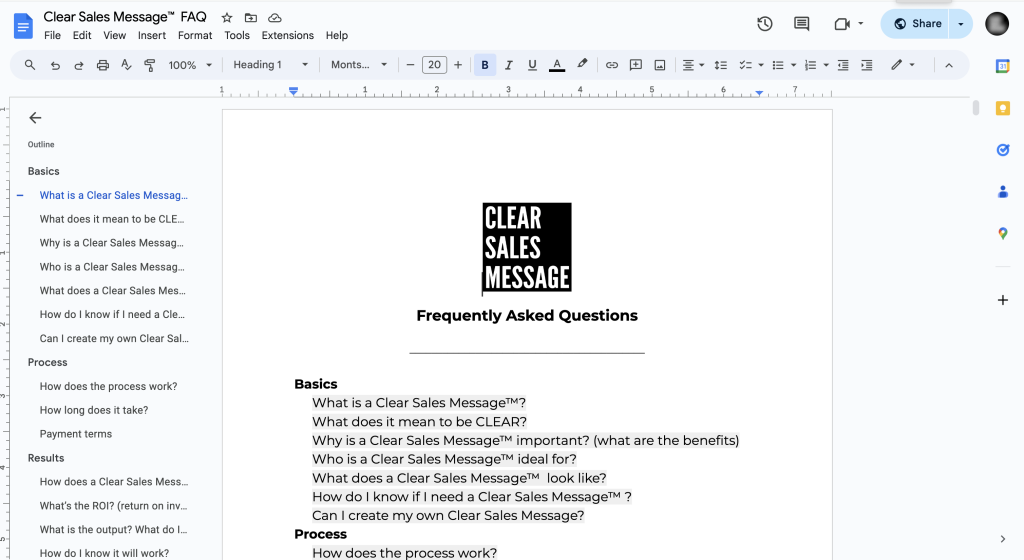
The structure mirrors the buyer’s journey through the decision. Basics first, then process, then results. A buyer who works through it leaves with far fewer reasons to hesitate.
Apple’s video-first FAQ
Apple pairs written FAQ answers with short video clips for key questions. Instead of reading about how much storage to get, the buyer watches a short explanation from a real person. Same answer, but the delivery is warmer, clearer, and far more engaging.
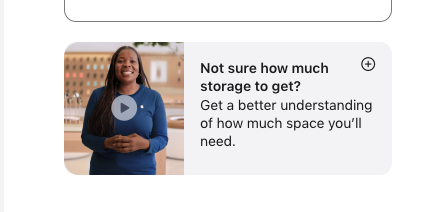
This is also a strong signal of confidence. A business willing to put a real person on camera stands behind its answers. That confidence transfers to the buyer.
See Also
- Troubleshooting
- The Emergency Action Plan
- 40+ ways to keep your buyer happy
- 140+ ways to be easier to buy from