
Practical Sales Training™ > How to connect with your buyer > FOMO

FOMO
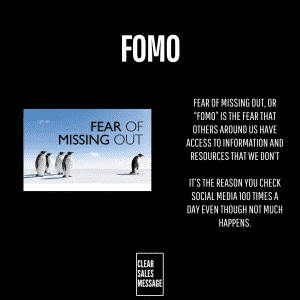
FOMO stands for Fear of Missing Out. It is the feeling that others have access to things you don’t. That could be details, moments, or results you are not part of.
Most people know the term. But few use it well in sales. When you understand how FOMO works, you can use it to move buyers without pushing them.
It connects to something deep in how we think and act. We are wired to avoid loss. In fact, the pain of missing out is stronger than the pleasure of gaining something new. So FOMO is not just a social media habit. It is a real driver of buying choices.
What Is FOMO?
FOMO is the Fear of Missing Out. It is the thought that others around you have access to things, details, or results that you don’t. When that thought takes hold, it creates a strong urge to act.
It works because it taps into nearly all of the four basic drivers. We want to grow, connect, learn, and do well. When we feel others are doing those things without us, we feel the pull to catch up.
That is why you check your phone over 100 times a day. The thought of missing a message is enough to keep you looking. It makes no logical sense, but it is very human.
Why Does FOMO Work?
FOMO works because it reframes inaction as a loss. Doing nothing stops feeling neutral. Instead, it feels like falling behind while others move ahead.
That shift is huge in sales. Because most buyers delay. They tell themselves they will think about it, come back to it, or wait until the time is right. FOMO breaks that habit by making the wait feel costly.
It also works because we care deeply about what others are doing. We compare. We notice gaps. When someone close to us gains something we haven’t, we feel it. So FOMO does not need to be invented. It just needs to be made visible.
How Can You Use FOMO In Sales?
In sales, FOMO creates urgency without pressure. Instead of pushing your buyer, you show them what they are missing. That shift changes how the message lands. Because the buyer feels the gap, not the push.
Use Social Proof to Create a Gap
The most basic form of FOMO in sales is social proof. You describe who has already bought, what they gained, and what changed for them. That creates a gap in the mind of the person reading or listening. They think: that could be me, but it isn’t yet. However, the real power comes when you get specific. A vague claim like “many clients have seen results” does very little. But a tight, real example hits differently. For example, the 27 people who downloaded this ebook now earn an extra £1k a month. That sentence works because it is specific, rare, and real. The reader is not one of the 27, and they feel it.
Use Information Gaps
You can also use FOMO through information gaps. When you hint at something the buyer doesn’t know yet, they want to find out. This is why subject lines like “What your rivals already know” get opened. The buyer fears being the last to catch on, so they click.
Use Scarcity and Deadlines
Deadlines and limited supply also trigger FOMO hard. When something is scarce, it feels more valuable. But it only works if the scarcity is real. False deadlines damage trust fast. So only use scarcity when it is genuine. Buyers are smart, and they notice when urgency is invented.
When FOMO Works Best
FOMO works best when your buyer already cares about the outcome. If they don’t want the result, there is nothing to miss out on. So build desire first, then let FOMO do its job.
It also lands better when the example is close to them. Showing a buyer that a similar business grew by 40% is more strong than a random case study. The closer the example, the sharper the FOMO. Because the buyer can picture themselves in the same position.
Timing matters too. Use FOMO at moments when the buyer is already engaged. When they are warm and interested, a well-placed FOMO message can tip the choice. Used too early, it just feels pushy.
When FOMO Becomes Dangerous
FOMO becomes dangerous when it tips into a trick. Fake scarcity, invented deadlines, and made-up social proof all destroy trust. When a buyer spots the trick, they don’t just walk away from the deal. They walk away from you.
Also, FOMO can feel manipulative when the buyer hasn’t yet understood the value. If they don’t see why your offer is good, showing them that others have bought it just feels like pressure. So the order matters. Build value first, then show what others are gaining.
Therefore, keep it honest. Use real examples, real numbers, and real timing. When FOMO is built on truth, it is one of the strongest tools in sales.
Common FOMO Mistakes
Using It Too Early
One common mistake is using FOMO before the buyer understands the value. If you trigger it too soon, it feels pushy. Build the desire first, then show them what others are gaining. Because FOMO only works when there is something worth wanting.
Being Too Vague
Another mistake is being vague. Generic claims like “join thousands of happy customers” create no gap. However, “the 14 firms who joined last quarter each saved 3 hours a week” creates a very clear one. Specifics make the gap real. Vague claims make it invisible.
Overusing It
A third mistake is overusing FOMO. If every message you send uses it, the edge is gone. Buyers tune it out, and it stops working. Use it at key moments, not as background noise. When it is rare, it lands hard. When it is everywhere, it means nothing.
FOMO – An Example
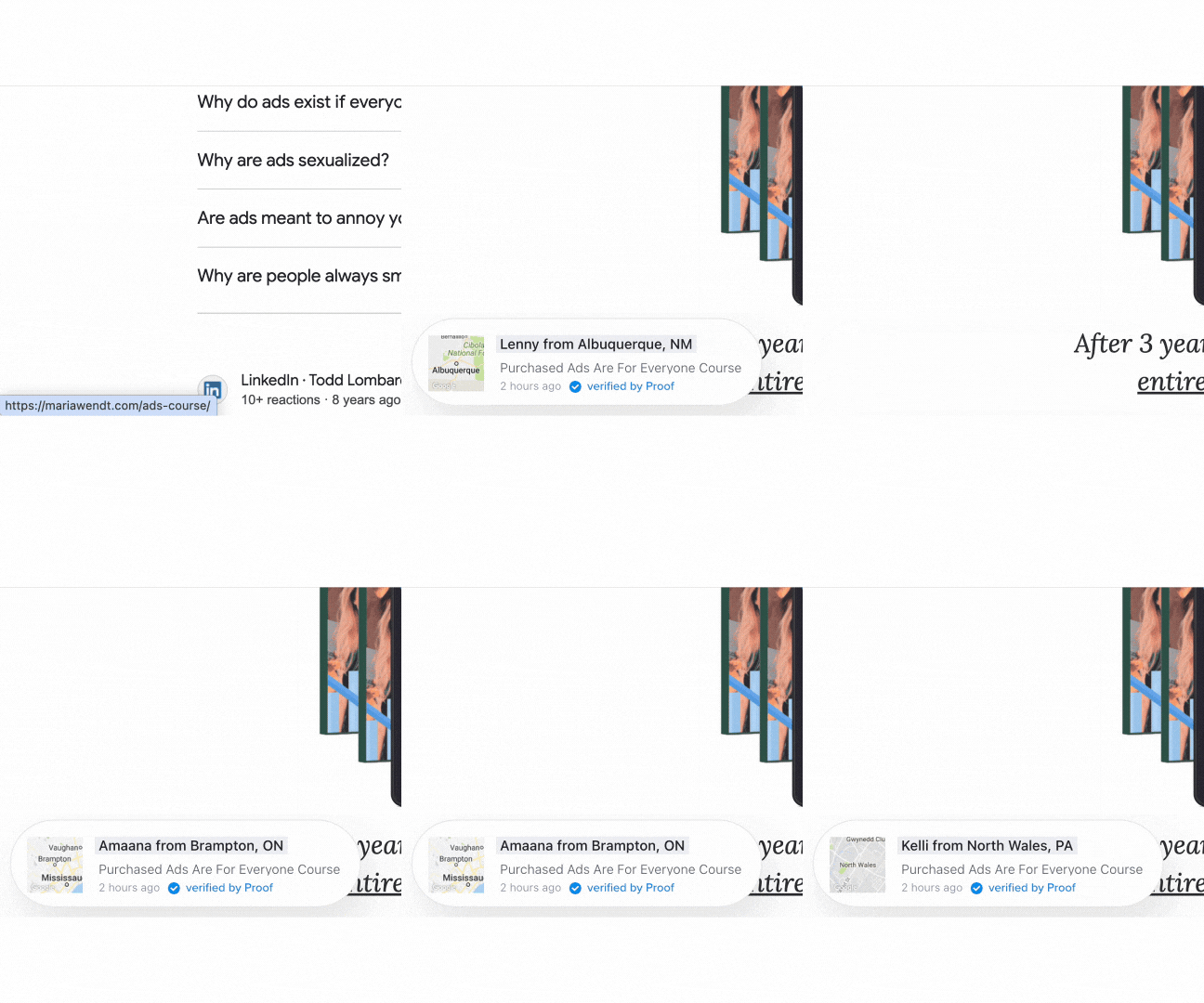
Lots of websites use proof-style widgets that show live activity. These show that what you sell is popular and that others are buying right now. For example, a widget that says “23 people are viewing this” or “7 sold in the last hour” creates instant FOMO. The buyer feels left behind if they don’t act. That feeling drives clicks, calls, and choices.
See Also
- The Inevitable Effect
- The Unfair Advantage
- The Whisper Effect
- 100+ ways to get your buyer to take action