

Practical Sales Training™ > How To Lose The Sale > Fake Personalisation
Fake Personalisation
Nobody wants to feel like one of five hundred. But that is exactly how Fake Personalisation makes your buyer feel. The message reads as though you know them. There is a vague compliment. A hint that you have done your research. But the cracks show quickly. And once they do, the damage is done.
I had one of these recently. An outreach email called me “buddy,” used generic praise, and showed no sign the sender knew anything about me. It took about three seconds to spot. And it did not make me want to reply. Instead, it made me want to block them.
Real personalisation signals effort and care. Fake Personalisation signals the opposite. In fact, it tells the buyer they were not worth the time it takes to actually learn something about them. That is a bad first impression to recover from.
What Is Fake Personalisation?
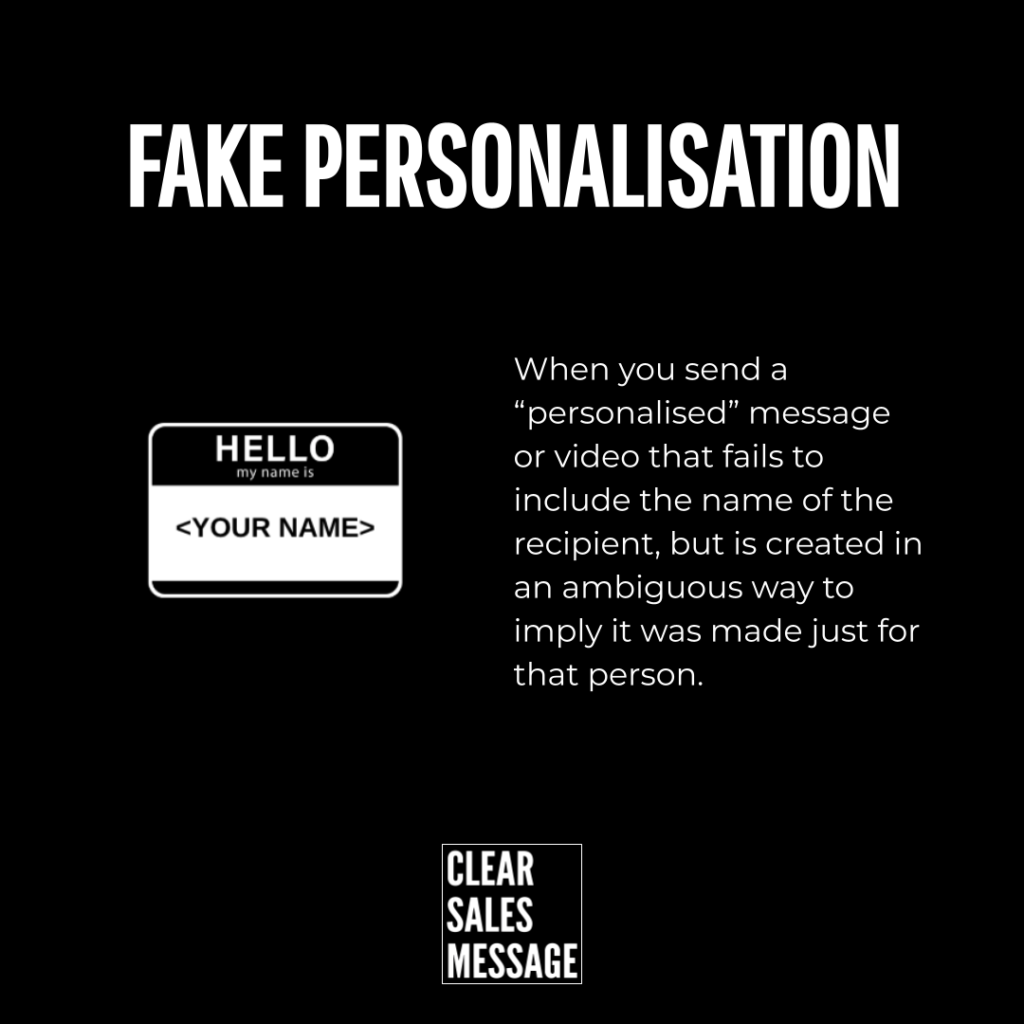
Fake Personalisation is when a message looks personal but is a mass-produced template with a few details swapped in.
It mimics the tone and structure of genuine outreach, but without doing any of the actual work. For example, the obvious signs are generic greetings, vague compliments that fit anyone, and claims with no evidence behind them. When all three appear together, the recipient knows immediately.
It is the opposite of real personalisation, which shows the buyer you invested time in them specifically. As the source page notes, Fake Personalisation is, at its core, a form of dishonesty.
Why Does Fake Personalisation Lose Sales?
It loses sales because it triggers the opposite response to what real personalisation creates. Genuine personalisation makes the buyer feel seen, valued, and ready to engage. Fake personalisation makes them feel misled. And a buyer who feels misled is not just unresponsive. In fact, they are actively less likely to trust you in future.
There is also a credibility problem. If you claim to know someone’s work but cannot name a single specific thing about it, the lie is obvious. And once a buyer catches you in one small deception, they apply that scepticism to everything else you say. So the whole message, and your whole offering, loses credibility.
The scale of the damage also increases when the fake message is easy to verify. If a buyer sees the exact same LinkedIn message sent to someone they know, they have proof. The word spreads. As a result, Fake Personalisation does not just lose one sale. It can lose a reputation.
How Can You Avoid Fake Personalisation?
Do the actual research
Real personalisation takes time. That is also exactly what makes it valuable. Before you reach out to someone, find something specific and genuine to reference. A post they wrote, a decision they made, a challenge their sector faces right now. When your opening line shows you actually looked, the whole message lands differently. And if you cannot find anything specific, the outreach may not be right for that person right now.
Use their name and something real
A name alone is not personalisation. Plenty of automated tools can insert a first name. What signals genuine effort is a specific detail. It shows you read, watched, or thought about this person as an individual. Even one real observation changes the entire tone of a message. It shifts you from sender to someone worth replying to.
If you are sending at scale, be honest about it
There is nothing wrong with reaching out to a large number of people. The problem is pretending each one is receiving a personal message when they are not. If your outreach is broadly targeted, frame it that way. A clear, honest message to the right audience will always outperform a fake personal one. Buyers can tell the difference, and they prefer the honesty.
Test your messages before you send them
Before you send, ask: if the recipient forwarded this, would it be clear it went to a hundred others? If the answer is yes, it still needs work. The best outreach messages feel written for one person. Even when they are not, the specificity should make them feel that way.
When Fake Personalisation Is Most Damaging
It is most damaging in high-value, relationship-led sales. When trust matters, a faked personal message sends exactly the wrong signal about how you work. If you cut corners on your first message, the buyer has reason to wonder what else you cut corners on.
It is also particularly damaging on LinkedIn and other platforms where messages are visible or shareable within a network. A mass message that reaches five people who all know each other is not just five bad first impressions. It is a public demonstration of poor judgement. And in tight sectors, this kind of thing travels fast.
And it is damaging in proportion to the claims made. The more you imply you know someone, the more obvious it is when you clearly do not. So overclaiming familiarity without evidence is worse than saying nothing at all.
Common Fake Personalisation Mistakes
Using generic terms instead of a name
Calling someone “buddy,” “friend,” or “hi there” is an immediate tell. It signals that you either do not know their name or did not bother to use it. A name costs nothing to find and use. Yet skipping it in favour of a vague greeting makes your message feel like junk mail with a casual font. It earns a delete before the second sentence.
Vague compliments with no substance
Phrases like “you’re doing great work” mean nothing when they come with no specifics. Because every recipient knows these phrases can be copy-pasted to anyone. So if you want to open with a compliment, make it real. Point to something real. Reference the post, the project, or the product. Specifics show you looked. Vague phrases show you did not.
Claiming familiarity you do not have
“I’ve been following your work for a while” is a common opener that often means nothing. So if you cannot back it up with a single specific detail, do not use it. Claiming you followed someone’s work and then citing nothing about it is worse than not claiming it at all. Instead, it turns a well-intentioned opener into a visible lie.
Fake Personalisation – An Example
The email that “buddy” killed
A marketing consultant sends 500 mass emails. Each one opens with: “Hey buddy, I think I can help.” No name. Not a single specific reference. No evidence of any research at all. Also, the same message appears on LinkedIn word for word. Recipients see it has gone to mutual contacts. The sender gets labelled a spammer and the message gets deleted.
Compare that to a real opening like: “Hi Sarah, I saw your recent post about launching your eco-friendly skincare line. I have a case study from a similar brand where we lifted e-commerce sales by 37% in three months. Would you like to see it?”
The second message shows evidence of research. It names the person, references something specific, and connects it to a relevant result. That is what real personalisation looks like. One message builds trust. The other destroys it.
See Also