
Practical Sales Training™ > How To Lose The Sale > Fake Discounting

Fake Discounting
Every sale has to end at some point. But some businesses never let the sale end. That discount runs on indefinitely. The “was” price stays, the strikethrough never goes away, and buyers quickly learn there is no full price.
When that happens, the discount stops being a deal and becomes the price. And once buyers know that, they will never pay more. They will wait for the next promotion. Or they will question whether the original price was ever real.
Fake Discounting is one of the fastest ways to erode the value of what you sell. It feels like a clever tactic. Over time, it becomes a trap.
What Is Fake Discounting?
Fake Discounting occurs in two main ways. One is when a brand or shop is always on sale, making it near-impossible to buy at full price. Another is when a product carries an inflated RRP it was rarely sold at. The discount is not a real reduction.
Both versions share the same problem. The original price is not genuine, because it exists only to make the discounted price look more attractive. No one is offering the buyer a real deal. They are being shown a price the seller wants them to think they are paying less than.
This overlaps with unrealistic discounting and is close to practices that consumer protection laws in many countries actively prohibit. So beyond the commercial damage, there can be a legal dimension to it too.
Why Does Fake Discounting Lose Sales?
It loses sales over time because it trains buyers to wait. Once a buyer has seen your product discounted enough times, they know there is no urgency to pay full price. Buyers delay. They wait for the next deal. Every promotion you run teaches them that a better offer is always coming.
It also erodes perceived value. Price is one of the signals buyers use to judge quality. A price that is always heavily discounted suggests a product that cannot sell at its full price. That creates doubt, not desire. And doubt is the enemy of conversion.
There is also a long-term profit problem. If buyers only ever purchase on promotion, your margin gets squeezed every time. The volume might look healthy, but the profit per sale shrinks. So Fake Discounting can make a business look busy while slowly making it less viable.
How Can You Avoid Fake Discounting?
Set a genuine full price and hold it
Your full price should be the price you are genuinely willing to sell at, and the price buyers regularly pay. If your full price is never the price anyone actually pays, it is not a real price. So set a price you can defend, sell at it consistently, and let genuine promotions be genuine. Discounts only mean something when the full price is real.
Make promotions time-limited and real
A promotion that ends creates urgency. One that never ends creates scepticism. So when you run a discount, set a real end date and honour it. When the promotion is over, the price goes back up. Those who have seen your promotions run on forever will simply wait.
Protect your full-price buyers
Every time a buyer pays full price and then sees the same product on sale a week later, trust erodes. So think about how you protect people who buy outside of promotions. This might mean advance notice of upcoming sales, price guarantees, or exclusive access to other perks. The buyers who pay full price are your most valuable customers. Treat them that way.
Use discounts to reward, not to rescue
The healthiest discount rewards loyalty, clears old stock, or gives a new buyer a reason to take a first step. It is not a mask for a price that was always too high. So before you discount, ask what the discount is for. If the honest answer is “to make the price look better than it is,” that is Fake Discounting.
When Fake Discounting Becomes Most Dangerous
It is most dangerous when buyers start talking about it. When enough people realise you are manufacturing your promotions, word spreads. Review sites, social media, and word of mouth can each carry the message that your prices are not real. Once that reputation takes hold, it is very hard to shift.
It is also dangerous in regulated sectors. In the UK and EU, specific rules govern reference prices. A “was” price must have been genuinely active before a promotion can use it. Breaching these rules can result in fines and public action. So the commercial damage of Fake Discounting can sit alongside legal and brand consequences too.
And it is most corrosive in premium markets. Buyers of luxury or high-value goods use price as a signal of quality. When a premium brand is always on sale, it stops feeling premium. The brand promise and the pricing behaviour pull in opposite directions, and over time the brand loses.
Common Fake Discounting Mistakes
Running perpetual promotions
A furniture store that always has a closing-down sale is not having a closing-down sale. In the UK, some furniture retailers have run the same “sale ends Monday” offer for years. Every buyer knows on Tuesday a new promotion will begin. The scarcity is false, the urgency is fake, and buyers price this in. So the result is a business where no one pays full price and no one believes the ticket price either.
Inflating the RRP to make the discount look bigger
A high RRP that the product rarely sells at exists to make the discount look bigger than it is. Buyers increasingly research this. Price-tracking tools, comparison sites, and historical pricing data make it easy to check whether a “was” price was ever real. If it was not, the buyer feels misled and the brand takes the hit.
Treating every sales event as a discount opportunity
Black Friday, January sales, Easter promotions, summer sales. A business in every sales event trains its buyers to expect a discount at every turn of the calendar. So be selective. Choose the promotions that make sense for your business and sit out the ones that do not. Scarcity of promotions makes each one more powerful.
Fake Discounting – An Example
The Black Friday price that was never a discount
This image shows exactly how Fake Discounting works. The product sits at $499.99 on Wednesday and also on Thursday. Then Black Friday arrives. The retailer crosses out $799.99, a price no one ever paid, and presents $499.99 as a deal.
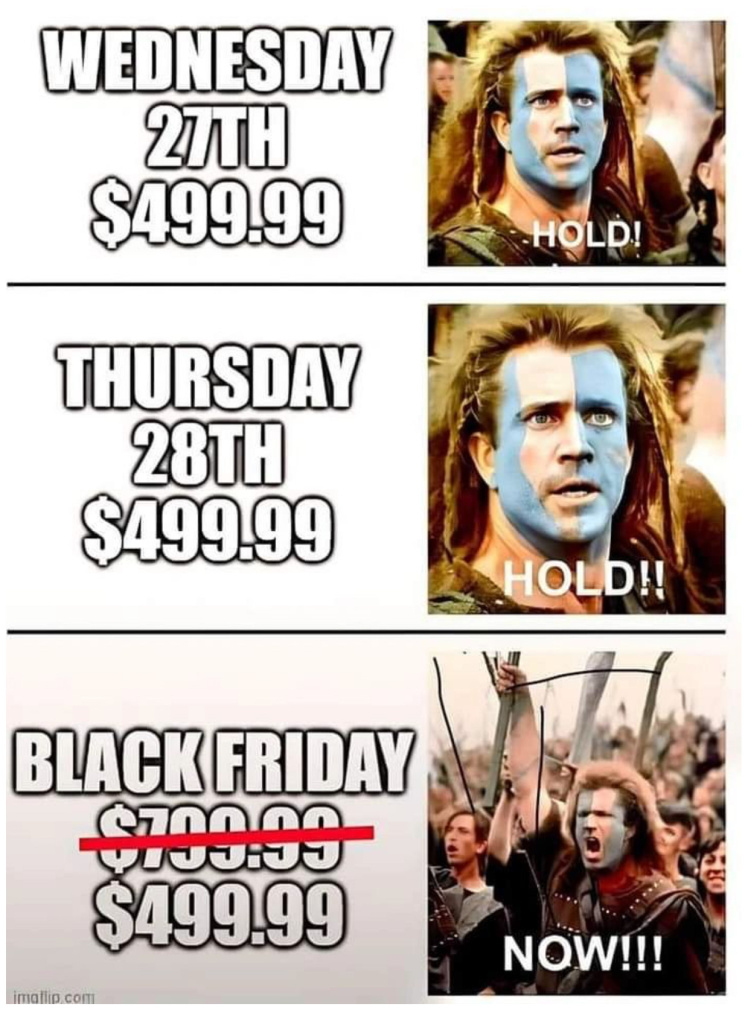
The price has not changed. Only the framing has. Buyers who were not paying attention may feel they are getting a bargain. But buyers who track prices, or simply notice the pattern, will see exactly what has happened. The “discount” is an illusion. And once a buyer spots that, they do not forget it.
See Also