

Practical Sales Training™ > How to connect with your buyer > Equivalence
Equivalence
Your buyer cannot buy something they do not understand. That sounds obvious, but it is one of the most common reasons deals stall. The product is good and the pitch is fine. But the buyer has not yet built a mental picture of what it is or how it works.
Equivalence fixes this. You take something familiar and use it as a bridge to the new thing. “It’s the Uber of hairdressing.” “It costs the same as a coffee a day.” One sentence, and the buyer clicks.
It is one of the quickest tools in sales. And it costs nothing to use.
What Is Equivalence?
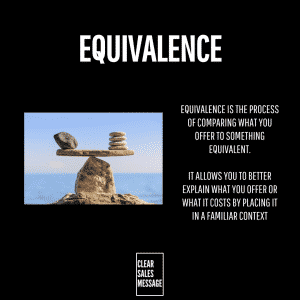
Equivalence is when you compare one thing to another in order to create a faster, clearer understanding. You anchor the unfamiliar to something the buyer already knows. The gap between confused and clear collapses.
It shows up in two main forms. One form is a concept comparison: you describe how something works by using something the buyer already knows. The other is a price comparison: you place a cost next to something the buyer already accepts. It no longer feels large.
In both cases, the power is the same. Rather than explaining more, you are connecting better. And if they don’t understand it, they can’t buy it. So that connection is often what turns interest into a sale.
Why Does Equivalence Work?
The brain learns by connecting new things to existing knowledge. When you give a buyer a familiar reference point, you reduce the mental effort of understanding. Instead of building a picture from scratch, they update one they already have. That is much faster and much more likely to stick.
It also works because it lowers the risk of confusion. Confusion kills sales. When a buyer does not quite follow what you offer, they default to caution and delay. Equivalence removes that hesitation by giving the brain something solid to hold onto.
There is an emotional side too. When a buyer recognises something familiar in your description, they feel capable of understanding it. That feeling of competence makes them more open and more engaged. So Equivalence does not just inform. It creates confidence in the buyer.
How Can You Use Equivalence In Sales?
Use a concept comparison to explain what you do
Find the thing your product is closest to in the buyer’s world and use it as your anchor. For example: “It’s the Uber of X.” The anchor does not need to be perfect. It just needs to give the buyer enough to start with. Once they have the basic picture, you can add the detail.
Use a price comparison to reframe cost
When a price feels large, it is often because the buyer has no context for it. Equivalence gives them that context. “It’s the same as a coffee a day.” These comparisons do not change the number. But they change how the number feels. So instead of the buyer weighing the cost against nothing, they weigh it against something they already accept.
Use Comparative Messaging to position against rivals
Equivalence also works when you need to explain where you sit relative to other options. Phrases like “We’re like X, but with more Y” give the prospect a quick read on your position. No long explanation needed. It also uses your rival’s familiarity to your advantage.
Keep it simple and familiar
The comparison only works if the reference point is something the buyer already knows well. If you compare your product to something the buyer has never heard of, you create two problems instead of one. So choose the most familiar, most obvious anchor you can find. The simpler the better. Clever comparisons are less useful than clear ones.
When Equivalence Works Best
Equivalence works best when you are introducing something new. If your product or model is unfamiliar, the buyer needs a bridge. The more novel the concept, the more a good comparison does for you. One well-chosen anchor can replace a page of explanation.
It also works well when price is a sticking point. If buyers keep hesitating at cost, it is often a context problem rather than a budget problem. Reframe the price through Equivalence and you change the standard the buyer measures it against. That shift alone can move a conversation forward.
And it works in any industry, with any buyer. Because understanding is universal. Every buyer in every sector benefits from clarity, and Equivalence is one of the fastest ways to deliver it.
When Equivalence Becomes Dangerous
The risk is a bad comparison. If the reference point carries negative associations, your product inherits them. “It’s like a timeshare, but for office space” might clarify the model. But timeshare brings baggage that could hurt you. So choose comparisons carefully and think about what feelings the reference point carries, not just what it describes.
A comparison can also oversimplify. Going too basic can undersell your offering or set the wrong expectations. The goal is a useful shortcut, not a full description. Make clear that the comparison is a starting point, not the whole story.
Finally, be careful with price comparisons. Comparing your fee to a coffee a day works when the numbers are genuinely small relative to the value. But if the comparison feels like a stretch, it can damage trust rather than build it. Only use price equivalences that your buyer will find credible.
Common Equivalence Mistakes
Using a reference point the buyer does not know
If the anchor is unfamiliar, the comparison creates confusion rather than clarity. This is a common mistake when selling to buyers outside your own world. What feels obvious to you may mean nothing to them. So test your comparisons. Ask yourself honestly whether the buyer you are talking to actually knows the reference well enough for it to work.
Over-relying on one comparison
A comparison opens the door. It does not close the sale. Once the buyer has the basic picture, move on and give them the substance. Returning to the same comparison throughout the pitch sounds like you have nothing more to say. Use it once, clearly, and then build on it.
Forgetting to follow the comparison with substance
Equivalence gets the buyer in the room. After that, you still need to show why your product is worth their time. A comparison is not a pitch. So once the buyer understands the basic idea, give them the detail that makes the case. A comparison starts the conversation. What you offer closes it.
Equivalence – An Example
The cola comparison that sells a new drink
This ad promotes a vitamin-enriched drink. One of the biggest hurdles for a new drink is taste uncertainty. Buyers hesitate because they cannot picture what it will be like. So the brand uses Equivalence to solve that problem before it starts.
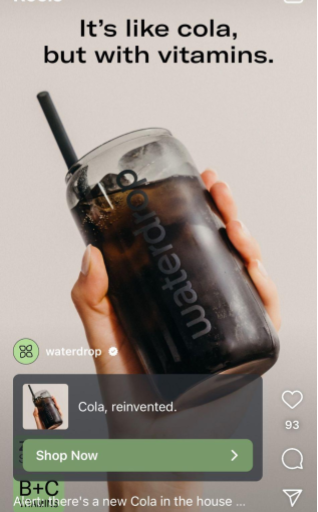
The ad says: “It’s like cola, but with vitamins.” That one line does a lot of work. It tells you the taste profile, positions it as a healthier option, and removes the uncertainty of trying something new. You know what cola tastes like. So now you know roughly what this tastes like too. The comparison does the selling before the buyer even reads the small print.
See Also