

Practical Sales Training™ > How To Get Attention > Descending Number List

Descending Number List
Too much choice kills sales. Buyers who feel overwhelmed do not buy – they stall, shop around, or walk away entirely. So if your offering is complex, varied, or covers a lot of ground, you have a problem to solve before you even get to the sale.
The instinct is to list everything you offer. But that usually makes things worse. More options create more doubt. More features create more questions. And every extra variable gives the buyer another reason to delay.
A descending number list flips this. It shows the scale of what you handle – then brings it down to one clear outcome. The buyer sees the complexity, but they also see that you will cut through it for them.
What Is a Descending Number List?
A descending number list is a simple structure that starts with your biggest number and works down to one. Each line represents a layer of your offering or the problem you solve. The final line is always the outcome the buyer actually wants.
It communicates the scope of your offering and shows buyers you can navigate complexity on their behalf. The numbers do not need to be exact – they just need to be honest and meaningful.
No long explanation is needed. The structure does the work because the contrast between the large opening number and the single outcome at the end tells the whole story in seconds.
Why Does a Descending Number List Work?
Buyers are not just purchasing your product or service. They are buying certainty. They want to know that despite all the complexity, they will end up in the right place – and a descending number list gives them that reassurance fast.
The large numbers at the top validate the difficulty of the decision. They signal: yes, this is complicated, and we know it. That builds trust because the buyer feels understood rather than sold to.
Then the list narrows to one. That one is always their outcome – their perfect kitchen, their personalised plan, their right answer. This shift from complexity to clarity mirrors how buyers actually think: overwhelmed at first, then relieved when someone shows them the way through.
How Can You Use a Descending Number List In Sales?
If your offering is large, varied, or involves simplifying a problem for your buyer, this format works well on websites, in proposals, on social media, and in sales conversations.
Start by listing the variables in your offering or the factors you deal with on behalf of your buyer. Aim for the largest numbers possible at the top, then work down to the single outcome your buyer cares about most.
Build Your List From the Buyer’s Problem
Think about what makes your buyer’s situation feel complex or uncertain. What are all the moving parts they have to deal with? Each one becomes a line in your list. The more variables you can name honestly, the more the buyer feels you understand their world – so do not rush to the final line. Let the complexity build first.
End With the Outcome, Not a Feature
The final line should name what the buyer gets – not what you do, but what they end up with. “One perfect kitchen” works because it is personal and specific. “One solution” falls flat because it is vague. Be precise about the outcome and the list will land every time.
Use It to Open a Conversation
This format is not just for marketing copy. Use it verbally in a sales call to frame what you do before you explain how you do it. Done well, it gives the buyer a quick mental map of your value and positions you as the guide through complexity rather than just another supplier.
When a Descending Number List Works Best
This format works best when your buyer feels overwhelmed or when choice is the main barrier to purchase. It is especially powerful for businesses with large product ranges, customisable services, or complicated buying processes. If a buyer’s default reaction to your offering is “I don’t know where to start,” a descending number list gives them a starting point – and an end point at the same time.
When a Descending Number List Becomes Dangerous
If the numbers feel inflated or made up, the format backfires. Buyers are not easily fooled – and if you claim 500 combinations but your actual range is limited, that gap damages trust the moment they look closer. Use real numbers, and make sure the final outcome line is genuinely what you deliver, not just a promise that does not hold up.
Common Descending Number List Mistakes
Most people either use the format too vaguely or miss the point of the final line entirely. Here are the two most common errors.
Making the Final Line About You
The last line should always be about the buyer’s outcome, not your capability. “1 expert team to help you” is about you. “1 clear path forward for your business” is about them. The format only works when the buyer can see themselves in that final line, so write it from their perspective, not yours.
Using Numbers That Do Not Mean Anything
Picking numbers at random just to fill the format is a mistake. Each number should represent something real and meaningful to the buyer. If you write “47 processes” but cannot explain what those 47 processes are, the number adds noise rather than confidence – and every line should be defensible if a buyer asks about it.
Descending Number List – An Example
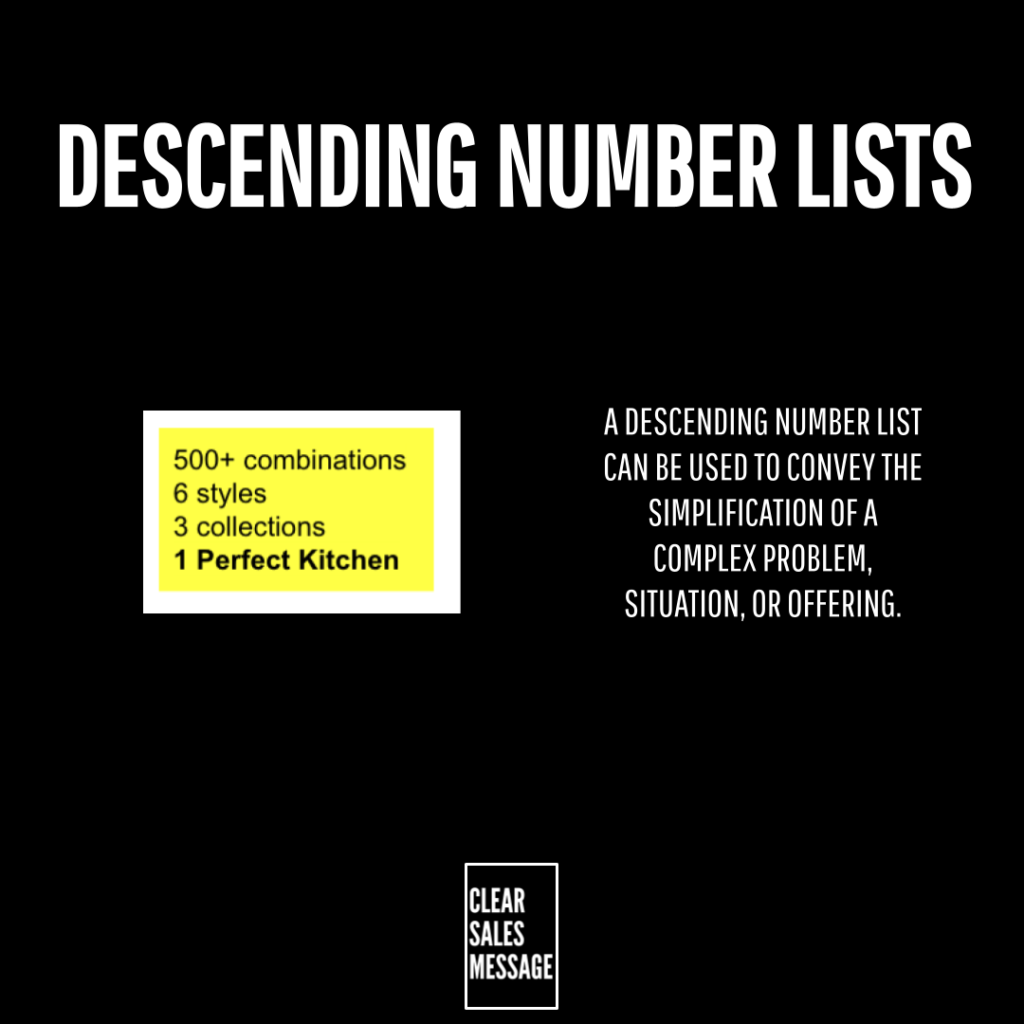
A kitchen retailer wants to reassure buyers who feel overwhelmed by too many choices. Rather than saying “we have hundreds of options,” they use a descending number list in their marketing:
“500+ kitchen combinations.
6 beautiful styles.
3 curated collections.
1 perfect kitchen – designed just for you.”
This frames the complexity of choice as a guided journey toward a single, clear result. The buyer sees that the range is vast – but also that the company will do the hard work of narrowing it down.
A coaching business might use the same structure:
“20 years of experience.
10 proven frameworks.
3 focus areas.
1 personalised plan for your success.”
In both cases the buyer gets context, confidence, and clarity in four lines. That is hard to beat.
See also
- Ascending Number List
- Big Number Effect
- Small Number Effect
- 100+ ways to seize buyer attention
- 140+ ways to be easier to buy from

