
Practical Sales Training™ > Wordplay > Assonance

Assonance
Some phrases just flow. You say them once and they feel right. Assonance is often the reason.
Unlike alliteration, which repeats the sound at the start of words, assonance works through the middle and end. It is the repeated vowel sound that gives a phrase its rhythm – subtle enough that most people never notice it, but powerful enough that they remember the phrase anyway.
In sales, that kind of quiet stickiness is valuable. A message that sounds good is easier to repeat. And a message that gets repeated travels further than one that simply makes sense.
What Is Assonance?
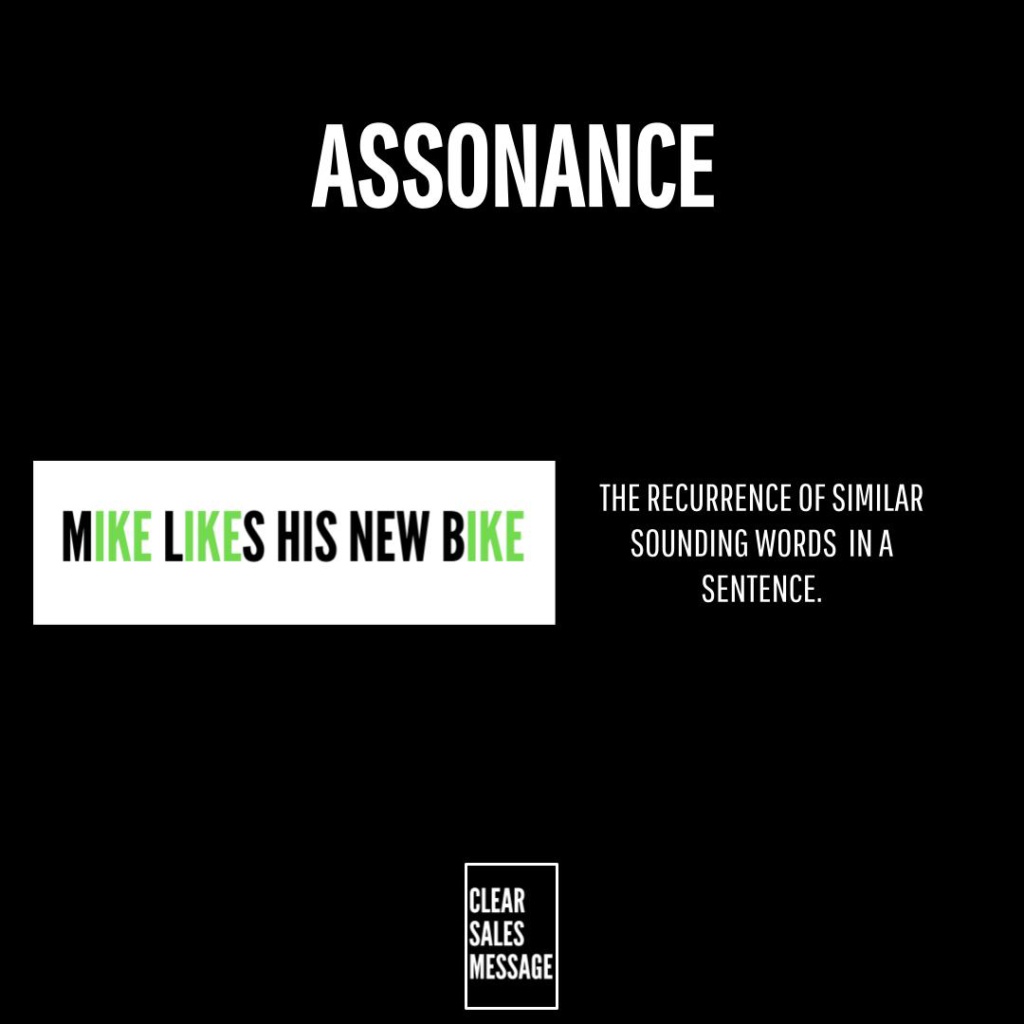
Assonance is the repetition of the same vowel sound across two or more words in a phrase or sentence. The words do not need to rhyme – they just need to share a vowel sound somewhere in the word, not only at the start.
For example, in the phrase “fly high, time to shine, it’s your sky” – the words fly, high, time, shine, and sky all carry the same “i” sound. The words look different on the page, but to the ear they feel connected. That connection is what makes the phrase mellifluous – smooth and pleasant to say.
Because assonance rarely happens by accident, a phrase built around it signals craft. And craft builds credibility, even when the listener cannot explain why the phrase feels more polished than others.
Why Does Assonance Work?
Assonance works because our brains find repeated sound patterns pleasing and easy to process. When vowel sounds echo across a phrase, the words feel like they belong together. So the message lands as a single unified idea rather than a string of separate words.
It also aids memory. Patterns are easier to recall than random sequences – and a phrase with a repeating sound has a pattern the brain can latch on to. As a result, the listener holds on to it longer without consciously trying to.
Similarly, assonance creates a sense of flow. A phrase that sounds smooth out loud is more enjoyable to say and hear. That enjoyment makes both the speaker and the listener more engaged – which matters enormously in a pitch or a first impression.
Finally, because most people never notice assonance consciously, it works without drawing attention to itself. The listener just feels that the phrase is good. They do not know why. But they remember it – and that is the whole point.
How Can You Use Assonance In Sales?
Use it in your tagline or strapline
Your tagline is the phrase people repeat when they describe what you do. So it needs to stick. Assonance helps by making the phrase feel smooth and natural to say. Pick your key message, then search for words that carry the same vowel sound. A quick Google search for words containing a specific sound – like “ike”, “ow”, or “ay” – gives you plenty of options to experiment with.
Apply it to your key benefit statement
When you describe the main thing you do for buyers, assonance can make that statement more memorable. For example, “we make growth feel real” uses the “ee” sound in make, feel, and real. The phrase flows naturally and stays with the listener because the sound pattern gives it shape.
Test it out loud before using it
Assonance is a spoken tool first. A phrase that looks fine on screen may feel awkward when you say it. Always read your phrase aloud several times before committing to it – because if it does not flow naturally in speech, it will not land in a pitch or a video script.
Combine it with other wordplay techniques
Assonance works well alongside alliteration and rhythm. However, do not force multiple techniques into the same phrase or it starts to feel overworked. One layer of sound craft is usually enough. The goal is a phrase that sounds effortless – not one that sounds engineered.
When Assonance Works Best
Assonance works best in short, punchy formats – taglines, subject lines, spoken pitches, and social media copy. These are the places where a phrase needs to land fast and stay in the memory. The shorter the phrase, the more each word carries – so sound craft at this level pays off quickly.
It also suits brands that want to sound considered and creative. Because assonance signals care in the use of language, it works well for businesses where the quality of communication is itself part of the brand. Consultancies, agencies, coaches, and premium service providers all benefit from language that sounds polished.
However, any business can use it. The technique is invisible to the listener – so even in technical or traditional sectors, a phrase built around shared vowel sounds will simply feel cleaner and more memorable than a flat alternative.
When Assonance Becomes Dangerous
Forced assonance is worse than none at all. If you twist a phrase to hit the right sound at the expense of meaning, the message suffers. Clarity always comes first. A phrase that sounds great but means nothing is a wasted opportunity.
It can also tip into sounding overly poetic in contexts where plain language is expected. In a technical proposal or a compliance document, for example, a highly musical phrase might feel out of place. So match the tone to the context before reaching for this tool.
Finally, do not confuse assonance with rhyme. Rhyme repeats the full ending sound of a word. Assonance is more subtle – it repeats only the vowel. So if your phrase starts to sound like a jingle, you have likely gone too far and need to pull back.
Common Assonance Mistakes
Choosing sound over meaning
The sound should serve the message, not replace it. If you use a weaker word just to hit the right vowel, the phrase loses clarity. Always start with the meaning you need to convey, then look for words with matching sounds – not the other way around.
Using it in the wrong context
A highly musical phrase in a formal pitch document can feel jarring. Because assonance adds a creative, almost lyrical quality to language, it suits conversational and marketing contexts more than technical ones. Think about where your message lands before you craft it.
Not testing it spoken
Assonance lives in the ear, not on the page. A phrase that looks good written down can still feel clunky when spoken. So always say it out loud – ideally to someone else – before you use it in a live pitch or record it. The mouth knows things the eye misses.
Overdoing it across a whole piece
One well-crafted assonant phrase stands out. Six of them in the same document start to feel like a pattern the reader notices and then finds distracting. So use assonance at the moments that matter most – your tagline, your opening line, your key benefit – and let the rest of the copy breathe.
Assonance – An Example
A travel company wants a tagline that feels exciting and open. Their first draft is: “See the world and enjoy your trip.” It is clear, but flat. So they rebuild it around a shared vowel sound.
The result: “Fly high, time to shine, it’s your sky.” The words fly, high, time, shine, and sky all carry the same “i” sound. The phrase feels smooth and almost musical – and as a result, it sticks in the listener’s mind long after the ad ends.
The information in both versions is similar. But the second version sounds like it was crafted with care. That perception of care raises the brand before a single other word is spoken.
See Also